What’s the difference between CBCT and regular dental X-rays?
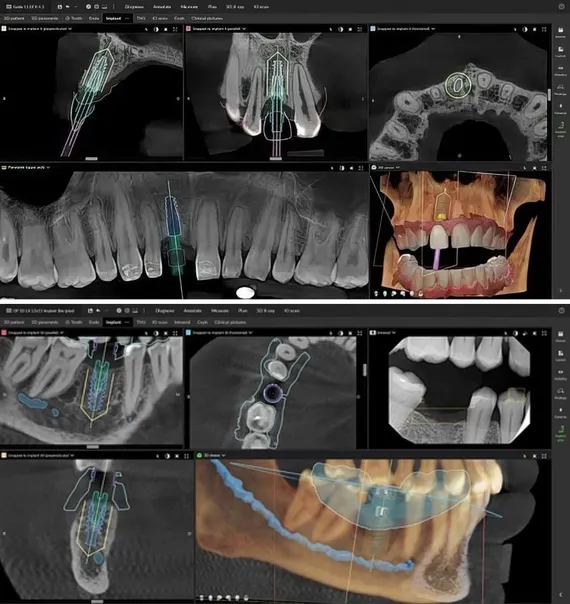
Traditional dental X-rays provide a flat, two-dimensional image. CBCT captures a three-dimensional view of the jaw, teeth, and surrounding structures, allowing for more accurate diagnosis and treatment planning.
What's the Difference between a CBCT vs. Panoramic X-rays:?
Panoramic X-rays (PANO) and Cone Beam Computed Tomography (CBCT) are both diagnostic imaging tools, but they differ significantly in the level of detail and clinical application:
- Panoramic X-rays provide a flat, two-dimensional image of the jaws, teeth, and surrounding structures. It is useful for general evaluations like tooth positioning, impacted teeth, or jaw relationships.
- CBCT scans capture a three-dimensional image that allows us to view structures from multiple angles and cross-sections. This is essential for precise treatment planning, especially for procedures like dental implants, periodontal surgery, impacted teeth, or pathology evaluation.
In short: PANO offers a broad overview, while CBCT delivers highly detailed, 3D insight — ideal when precision matters.
How long does the scan take?
The entire scan usually takes under one minute. The actual imaging process takes about 10 to 20 seconds.
Do I need to prepare for the scan?
No special preparation is required. We may ask you to remove earrings, glasses, or metal hair accessories, as these can interfere with the image quality.
Is it uncomfortable?
Not at all. You’ll be asked to sit or stand still while the machine rotates around your head. The process is quick and completely painless.
Will insurance cover it?
Many dental insurance plans do cover CBCT scans when they are medically necessary. We’ll help you check your benefits and discuss any expected out-of-pocket costs prior to your scan.
Is the radiation from a CBCT scan safe?
Yes. CBCT uses significantly less radiation than a traditional medical CT scan and is focused only on the area being evaluated. We use CBCT only when clinically necessary and always adhere to the ALARA principle (As Low As Reasonably Achievable).
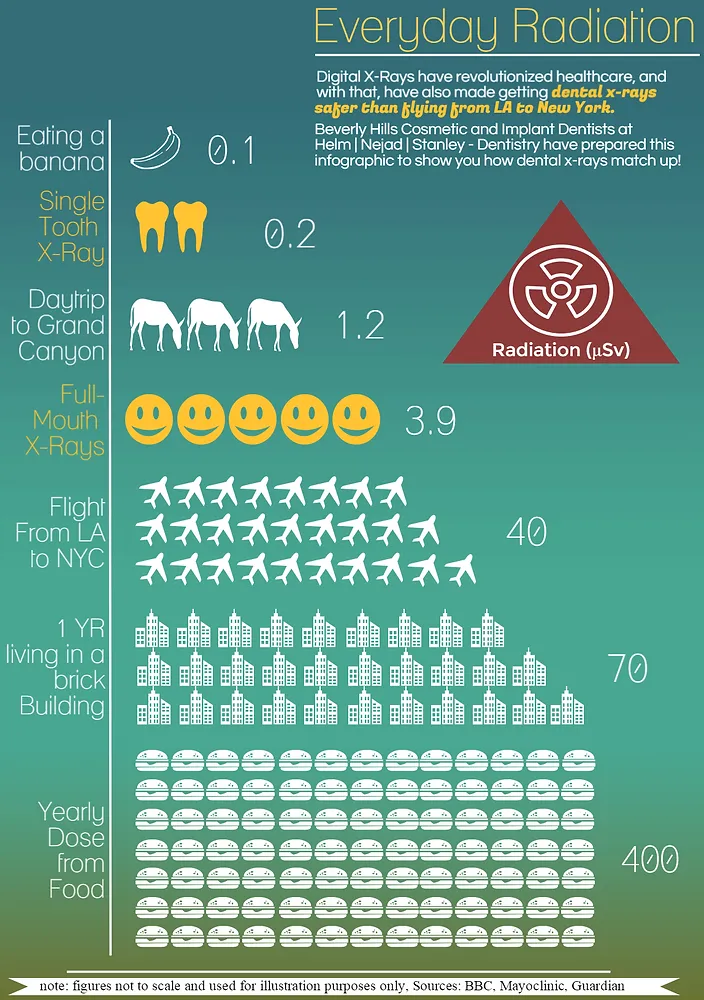
Radiation Dosage: CBCT and Everyday Exposure
The Vatech Smart Plus CBCT unit is engineered with low-dose imaging protocols while maintaining high-resolution detail.
Approximate Radiation Dose
- One full arch CBCT scan (Vatech Smart Plus): ~40–100 µSv
(depending on settings, field of view, and patient size) - Traditional panoramic X-ray: ~14–24 µSv
- Digital full mouth series (FMX) with bitewings: ~150–200 µSv
- Daily natural background radiation (average U.S. exposure): ~8–10 µSv/day
- One cross-country flight (coast to coast): ~35–50 µSv
Perspective: A full-arch CBCT scan from the Vatech Smart Plus typically delivers less radiation than a full-mouth X-ray series and is comparable to or less than a single coast-to-coast airplane flight.
We strictly follow ALARA (As Low As Reasonably Achievable) protocols, using the smallest field of view and lowest effective dose necessary for accurate diagnosis and treatment planning.