Are dental X‑rays really necessary?
Yes. X‑rays help us detect issues such as cavities, bone loss, root fractures, and periodontal disease—not always visible in a clinical exam. Early detection allows us to treat problems before they become more serious and costly.
How often do I need dental X‑rays?
Frequency varies based on your individual risk and oral health. The ADA/FDA guidelines emphasize that imaging should be clinically justified, not performed on a routine schedule. Only bitewing frequency has defined intervals:
How is the decision made?
Our approach follows the ADA‑FDA radiation selection criteria:
- Consider your caries risk, periodontal status, clinical findings, and medical history
- Use professional judgment to decide if X‑rays are necessary at that moment
- Always apply the ALARA principle (As Low As Reasonably Achievable) to minimize exposure
Are digital X‑rays safer?
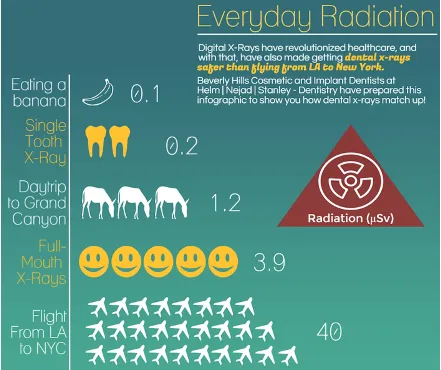
Yes. Digital radiography uses up to 80–90% less radiation than traditional film X‑rays while offering sharper images. Exposure from a set of bitewings is roughly equivalent to one or two days of average environmental background radiation
Can I have X‑rays taken during pregnancy?
With proper shielding and only when clinically necessary, X‑rays may be performed during pregnancy. Non-urgent imaging is usually postponed until after delivery. Please inform us if you are pregnant or believe you may be pregnant
Do insurance policies limit X‑ray coverage?
Yes, insurance plans often impose limits on the frequency of imaging. However, if a scan is clinically necessary and outside the usual interval, it may still be covered with proper documentation. We’re happy to help verify your benefits in advance
Here’s an enhanced FAQ section for your Low Exposure Digital X‑Rays page, now including ADA guidelines on imaging frequency and professional decision-making frameworks: